
TLDR
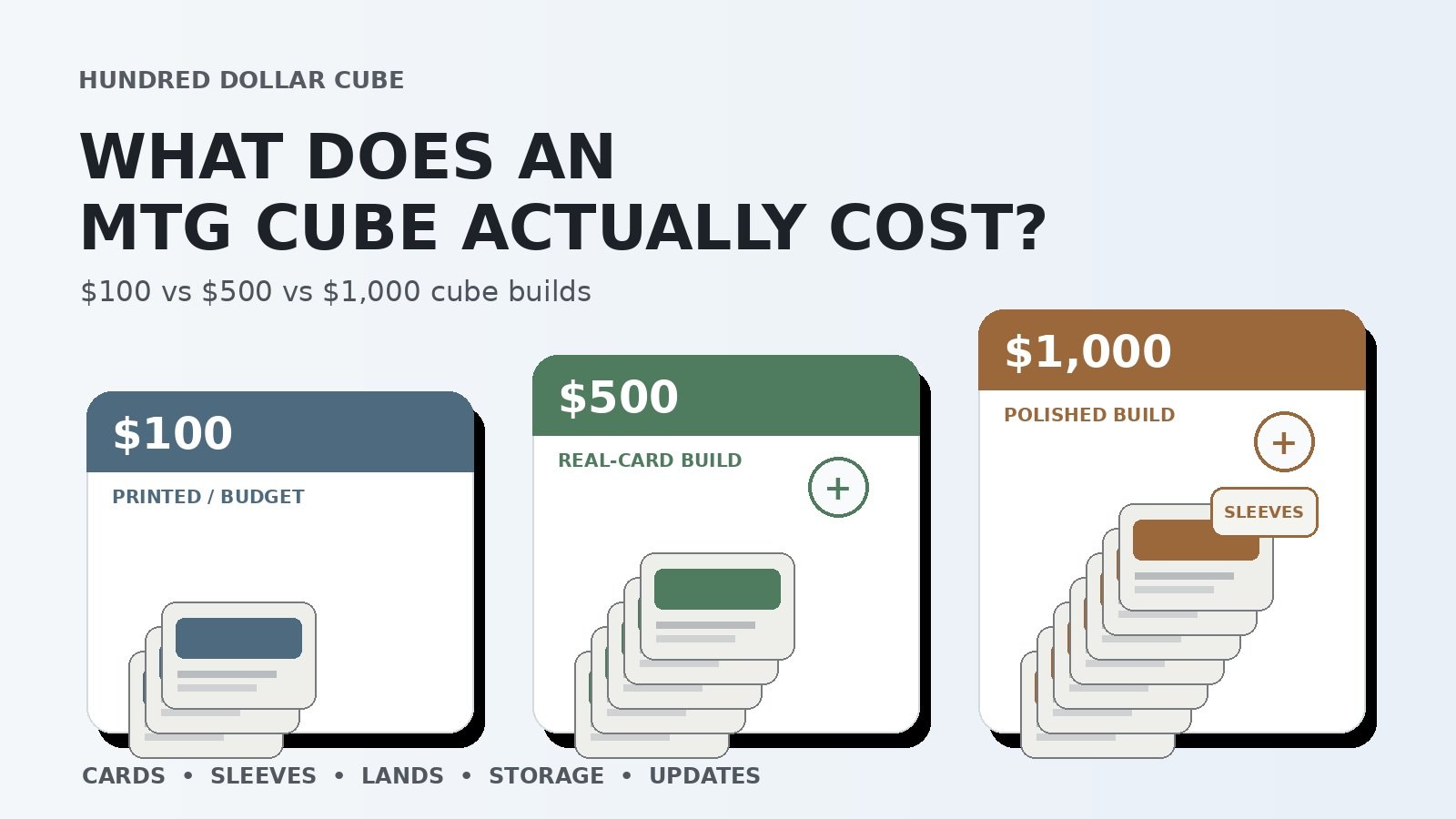
- MTG cube cost can range from almost nothing to tens of thousands of dollars. The useful question is what you actually get at different practical budgets.
- Around $100 can buy the card pool for a complete printed proxy cube, but a true from-scratch setup still needs sleeves, basic lands, and storage.
- Around $500 gives you enough room to build a strong budget cube from real Magic cards, especially if you avoid expensive staples and use cards you already own.
- Around $1,000 can support a very polished real-card cube with better mana, stronger staples, and fewer budget substitutions.
- None of those budgets requires a worse draft. Expensive cards raise the financial ceiling of the card pool. They do not automatically improve archetype balance or gameplay.
- Sleeves, storage, basic lands, tokens, replacements, and future updates are part of the real cost too.
There is technically no upper limit to MTG cube cost.
You can build one from cards sitting in a box in your closet and spend almost nothing. You can also build a fully powered Vintage Cube with authentic old cards and arrive at a number best discussed with your insurance company.
Neither extreme is very useful when someone asks, “How much does it actually cost to build a cube?”
So I prefer three more practical budgets: $100, $500, and $1,000.
Those numbers produce very different physical cubes. But perhaps not in the way you would expect.
A $1,000 cube does not draft ten times better than a $100 cube. In fact, a tightly designed budget environment can be better than an expensive pile of staples.
The money mostly changes how you obtain the cards, which cards you can use, and how many compromises you need to make around expensive lands and staples.
First, What Counts Toward MTG Cube Cost?
The card list gets all the attention, but a physical cube is a small game system.
You may need:
- the cube cards themselves
- opaque sleeves
- basic lands
- sleeves for those basic lands
- tokens
- dice and counters
- a storage box
- dividers
- replacement sleeves
- optional reusable booster packs or pack shells
And there is another cost that never shows up in a shopping cart: time.
Buying 540 individual cards from multiple sellers, checking editions, replacing expensive cards, sleeving everything, sorting it, and maintaining a list can take a while.
That may be fun. Cube building is a hobby on its own.
But it is still part of the tradeoff.
The $100 MTG Cube
Let’s start at the bottom.
HundredDollarCube currently offers a complete 540-card printed Modern Cube for $100. Its site is quite explicit about what the price includes and what it does not: you get the cube cards, while sleeves and basic lands are supplied separately.
That distinction matters.
A $100 card pool is possible.
A $100 everything-included physical setup starting from an empty desk is harder.
If you already have several hundred sleeves, a stack of basic lands, and an old card box, however, $100 can get remarkably close to the finished product.
What a $100 Cube Budget Is Good At
At this tier, I would choose one of three approaches.
1. A professionally printed proxy cube
This gives you enormous freedom in the list. Expensive fetch lands, powerful staples, old cards, and hard-to-find cards do not blow up the budget one at a time.
2. A real-card Pauper or Peasant cube
Commons and uncommons can create excellent Limited environments without relying on expensive rares.
3. A cube made mostly from cards you already own
If you have years of draft leftovers and bulk, your actual cash cost can be very low.
The catch with option three is that “cards I happen to own” is not a design philosophy. You still need to build archetypes, mana curves, removal, fixing, and color balance intentionally.
The Hidden Expense at $100
Sleeves.
A 540-card cube needs at least 540 identical sleeves before you even get to basic lands. Realistically, you also want spares.
Your land station may add another hundred-plus sleeved cards depending on how you organize it.
Storage can be nearly free if you use a basic cardboard card box. Or it can become its own hobby if you decide you need a wooden case with individual reusable packs.
At this budget, use what you already own.
There is no gameplay bonus for making the storage box cost more than the cube.
A Realistic $100 Cube Setup
If the cube itself consumes the whole $100 budget, I would build the rest around existing supplies:
| Expense | Practical $100 Approach |
|---|---|
| 360–540 cube cards | Printed cube, bulk collection, or inexpensive singles |
| Sleeves | Reuse a matching set you already own |
| Basic lands | Pull them from your collection |
| Tokens | Use existing tokens, dice, or printed references |
| Storage | Standard cardboard card box |
| Updates | Swap cards gradually |
HundredDollarCube’s own model follows this basic idea: keep the card pool inexpensive and let common cube supplies such as sleeves and lands remain reusable.
If you need to purchase every accessory from scratch, plan to exceed $100.
That is not the budget failing. It just means the $100 figure is paying for the cube rather than an entire new collection of accessories.
The $500 MTG Cube
At $500, the decision gets more interesting.
You can still proxy anything you want, of course. But now a real-card budget cube becomes much easier to build.
The trick is not to take a $5,000 cube list and replace every expensive card with the cheapest card that looks vaguely similar.
Build for the budget from the beginning.
A lot of strong Limited cards cost very little because Limited power and Constructed market price are two different things.
A three-mana uncommon that holds an archetype together might be exactly what your cube needs even if nobody is putting it into a competitive Modern deck.
Budget cube designers have used this idea for years: build around overlapping archetypes and inexpensive role-players instead of assuming rares and mythics are necessary for a good environment. Card Kingdom’s budget-cube discussion, for example, specifically highlights signpost uncommons and synergy as ways to make a coherent cube without expensive staples.
One Way to Divide a $500 Budget
This is not a price quote. It is a useful planning framework:
| Category | Sample Budget |
|---|---|
| Cube cards | $330 |
| Sleeves and spare sleeves | $80 |
| Basic land setup | $20 |
| Storage | $40 |
| Tokens, dividers, miscellaneous | $30 |
| Total | $500 |
If you already own sleeves, lands, or storage, move that money into the card list.
If you own 150 cards from the eventual cube already, even better.
That is why two people can build the exact same cube and report very different costs.
What Should You Spend the Extra Money on First?
If you move from a $100 card budget toward $500, I would not immediately buy expensive finishers.
Spend on the structural cards.
For many cubes, that means mana fixing.
Better land cycles make more cards draftable. They help players splash. They make gold sections less punishing. And they reduce games where someone drafted a good deck and then spent turn four staring at the wrong lands.
After fixing, I would look at cards that are genuinely difficult to replace:
- unique build-arounds
- important one-mana interaction
- efficient removal
- archetype glue
- flexible modal cards
- cards that support several decks at once
I would spend less aggressively on expensive cards whose job can be handled by a twenty-cent alternative.
If your $25 five-mana creature and your $0.40 five-mana creature are both basically “large threat that ends the game,” your cube may not care which one has the higher market price.
The $1,000 MTG Cube
A $1,000 cube can be very nice.
But the budget still disappears faster than people expect.
Imagine you reserve roughly $150 for sleeves, storage, lands, tokens, and spare supplies.
That leaves $850 for 540 cube cards.
The average available budget is then only about $1.57 per card.
That is enough for a huge number of strong Magic cards.
It is not enough to blindly import an expensive Vintage Cube list.
A handful of costly lands or Reserved List cards could consume the budget by themselves.
This is why the best $1,000 build is usually a deliberate environment, not an expensive cube with 40 missing cards.
What $1,000 Actually Buys You
Compared with $500, the extra money can improve several areas.
Better Mana
You can use stronger dual-land cycles and more desirable utility lands without every land slot becoming a budget debate.
Fewer Compromise Cards
At $500, you may sometimes play “the cheap version.”
At $1,000, you can choose the card you actually want in more slots.
More Expensive Archetypes
Some strategies rely on cards with real Constructed demand. A larger budget lets you support those packages without sacrificing the rest of the cube.
More Stable Long-Term Ownership
You can sleeve the cube well, give it a permanent storage solution, keep spare sleeves around, and stop rebuilding its physical infrastructure every six months.
What $1,000 does not automatically buy is balance.
You can still build a $1,000 cube where aggro is terrible, fixing is scarce, every green card costs five mana, and half the gold section never gets drafted.
Money cannot fix the skeleton.
$100 vs $500 vs $1,000 Cube Builds
Here is how I would think about the three levels.
| Budget | Best Fit | Main Advantage | Main Tradeoff |
|---|---|---|---|
| $100 | Proxy cube, Pauper/Peasant, collection-built cube | Maximum gameplay per dollar | Accessories can push true cost higher |
| $500 | Budget real-card cube | Strong environment with lots of real cards | Expensive staples still require substitutes |
| $1,000 | Polished real-card cube | Better fixing and fewer compromises | Still far below unrestricted Vintage pricing |
The interesting part is that all three can support excellent drafts.
Your group is not going to leave saying, “That was only $0.74 of gameplay per pick.”
They are going to remember whether decks came together.
Proxy Cube vs Real-Card Cube Cost
Proxies fundamentally change cube economics because cube is a closed casual environment.
With real cards, the market price of each individual card matters.
With printed play pieces, the cost tends to depend much more on how many cards you print.
That means a 540-card budget Modern environment and a 540-card cube full of historically expensive cards can have similar printing costs even though authentic versions would have wildly different values.
This is one reason cube is such a natural use case for proxies.
It lets you choose the environment first and solve the acquisition problem second.
HundredDollarCube describes its own printing approach around that exact use case: a large, consistently produced stack intended for repeated drafting and shuffling rather than a collection of individually sourced cards.
For casual groups that are comfortable playing with clearly unofficial cards, it removes market price from the cube-design equation.
For collectors who enjoy owning the actual cards, the real-card route has a completely different appeal.
Neither answer is universally correct.
Do Not Forget the Cost of Updates
Cube has a habit of never being completely finished.
A new set releases.
You see three cards you want to test.
One sticks. Two come back out. Six months later you replace another ten.
With inexpensive cards, this barely matters.
With an expensive real-card cube, constant updates can become a meaningful ongoing cost.
So I would separate your budget into two numbers:
Initial build cost
and
annual maintenance cost
You do not need a formal spreadsheet unless you enjoy that sort of thing. Just recognize that spending every dollar of your budget on day one leaves no room for future changes.
I would rather build a $900 cube with $100 left for updates than spend exactly $1,000 and feel obligated to defend every existing card forever.
Smaller Cubes Cost Less
There is also a very simple way to reduce MTG cube cost:
Build fewer cards.
A 360-card cube is enough to run a classic eight-player draft with three 15-card packs per player. A 540-card cube provides more variation because a normal eight-player draft only uses 360 of its cards.
That distinction has financial consequences.
At the same average card value:
- 360 cards cost less than 540
- 360 cards need fewer sleeves
- 360 cards need less storage
- 360 cards require fewer updates
- 360 cards make every individual card appear more often
If your normal draft group is four to eight people, a carefully built 360-card cube can be the most efficient way to put money into card quality instead of card quantity.
A 540-card cube makes sense when you specifically want greater replay variety.
Use What You Already Own
The easiest way to make a $500 budget behave like a $700 budget is to inventory your collection first.
Look for:
- lands
- removal
- signpost uncommons
- cheap staples
- playable rares
- tokens
- matching sleeves
- storage boxes
Do this before ordering anything.
A $4 card you already own costs you zero dollars to put in the cube.
And if you already have a land station and 600 matching sleeves from an old project, a huge chunk of the setup budget just disappeared.
This is especially important for longtime players. The cards sitting in draft chaff boxes may not be valuable, but that does not mean they are bad cube cards.
Expensive Does Not Mean Better
This is probably the most important point in the entire MTG cube cost discussion.
Cube power and cube quality are not the same thing.
A $100 synergy cube can have:
- clear archetypes
- close games
- useful draft signals
- strong interaction
- interesting build decisions
- excellent replayability
A $10,000 cube can have none of those things.
Expensive cards tend to give you access to famous staples, older cards, premium lands, and very high-power environments.
That is useful if those are the things you want.
But a cube is ultimately a Limited format you designed.
Spend money where it improves that format.
Do not spend it because a price tag makes a card feel important.
My Pick at Each Budget
At $100, I would print the complete card pool and reuse sleeves, basics, and storage I already own. If I wanted real cards only, I would build Pauper, Peasant, or a small collection-based cube.
At $500, I would build a real-card 360-card cube rather than stretching the budget across an unnecessarily large list. I would prioritize fixing, cheap archetype support, and cards that belong in several decks.
At $1,000, I would build the strongest version of that real-card environment that the budget allows. Better lands. Better interaction. A few costly cards that genuinely add something unique. But I would still skip expensive staples that are easy to replace.
And if my real goal were a powered or high-end Vintage-style environment?
I would proxy it.
There is not much design value in deleting the cards that define your format simply because authentic copies would wreck the budget.
So What Does an MTG Cube Actually Cost?
The shortest answer is:
A playable cube can cost around $100. A nice real-card cube can comfortably become a $500–$1,000 project. And a high-end authentic cube can go far beyond that.
But the sticker price is not the important part.
Think about what you are paying for.
At $100, you are buying access to the format.
At $500, you can start combining good physical components with a substantial real-card collection.
At $1,000, you gain much more freedom over card selection.
After that, spending more money increasingly becomes a question of collecting preference, power level, specific staples, and how much you care about owning authentic versions.
Cube does not have to be expensive.
It just has an unusually high ceiling if you decide it should be.
FAQs
How much does it cost to build an MTG cube?
It can cost almost nothing if you build from an existing collection, around $100 for some complete printed proxy card pools, several hundred dollars for a budget real-card cube, or many thousands for a high-end authentic cube.
Can you really build a 540-card cube for $100?
Yes, as a printed proxy card pool. HundredDollarCube currently lists a 540-card Modern Cube at $100. Sleeves, basic lands, and other accessories are separate, so a player starting completely from scratch should expect a higher total setup cost.
Is a 360-card cube cheaper than a 540-card cube?
Usually. It requires 180 fewer cube cards, fewer sleeves, and less storage. A 360-card cube is also enough for a traditional eight-player draft using three 15-card packs per player.
Is $500 enough for a real-card cube?
Yes. A $500 budget can support a strong real-card cube if the list is designed around the budget. Avoiding expensive staples and using inexpensive archetype cards matters much more than trying to reproduce a high-priced existing list card for card.
Should I proxy expensive cards in my cube?
For casual playgroups that agree to proxies, cube is a practical place to use them. Proxies let you test expensive cards and build environments whose gameplay would otherwise be restricted by card prices. Make sure your group is comfortable with them and keep playtest cards clearly distinct from authentic cards.
References
- HundredDollarCube, Home and 540 Card Modern Cube. Current site pricing lists its 540-card Modern Cube at $100 and identifies basic lands and sleeves as separate setup items.
- HundredDollarCube, How We Print the Hundred Dollar Cube. Describes the site’s approach to producing a consistent cube intended for repeated handling and drafting.
- Card Kingdom, Building a Budget Cube. Discusses building around inexpensive synergy pieces and signpost uncommons instead of relying on high-priced cards.
- HundredDollarCube, MTG Cube Draft Formats. Covers the traditional three-pack cube draft structure and card requirements for different draft formats.
Intent Sentence: This post helps MTG players decide how much to spend on a cube by comparing $100, $500, and $1,000 approaches and accounting for cards, proxies, sleeves, lands, storage, and updates, so they can choose a budget that fits the cube they actually want to play.