
TLDR
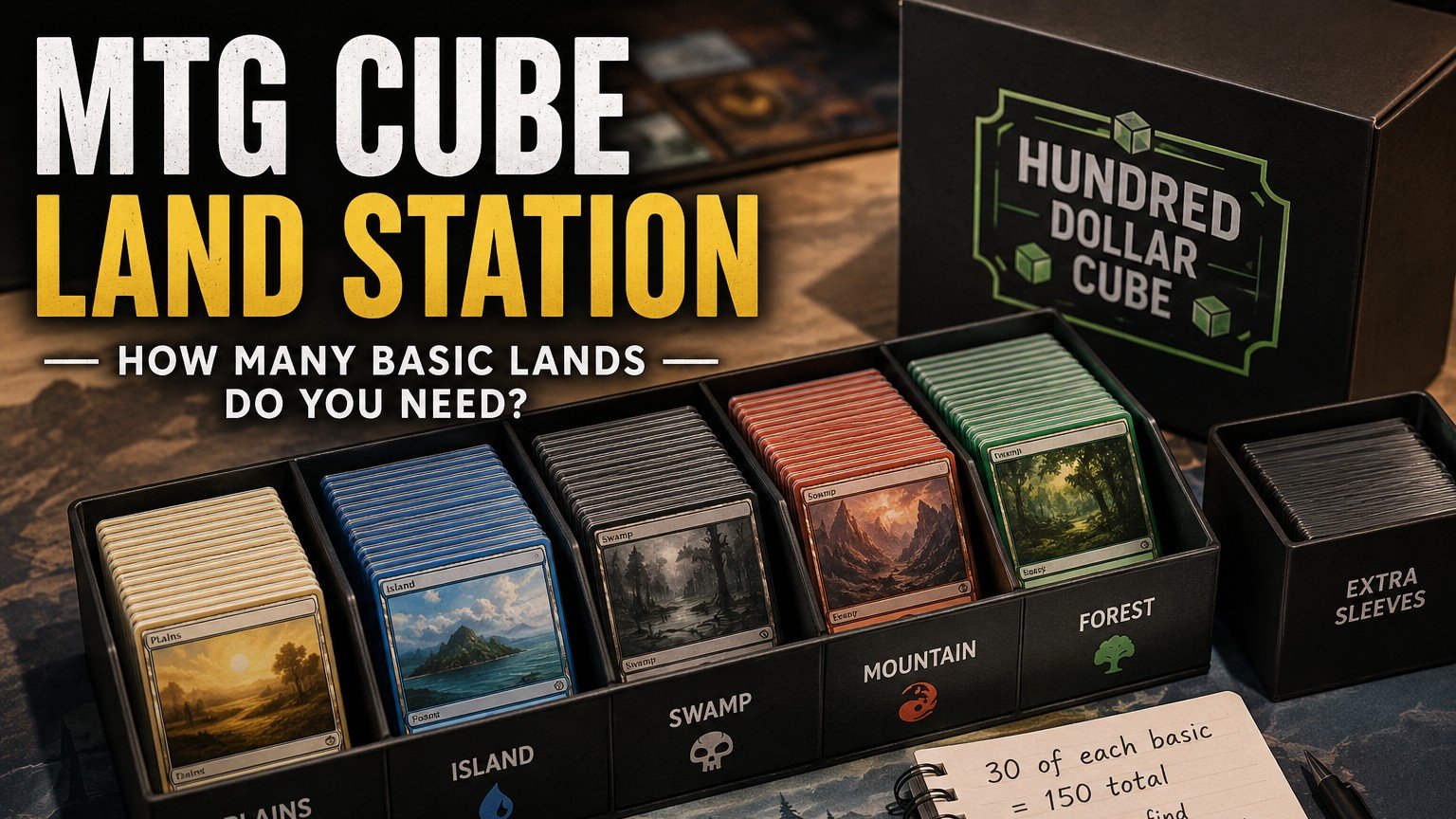
For most cube owners, the clean answer is 150 basic lands, or 30 of each color. That is the easiest, least annoying starting point for an MTG cube land station, especially if you usually draft with 6 to 8 players.
If you want the “nobody ever complains about Islands again” setup, go with 200 basic lands, or 40 of each color. For a 540-card cube like the Hundred Dollar Cube, that gives you enough basics, enough sleeve consistency, and enough breathing room that setup does not become the secret sixth color of Magic: mild panic.
Why Your MTG Cube Land Station Matters
An MTG cube land station sounds boring until the first draft ends and three people are digging through a shoebox looking for Swamps. Suddenly, your powerful cube night has turned into a bulk land archaeology project.
The cube itself is the exciting part. The land station is the part that keeps the night moving.
A good land station does three things:
- Lets everyone build 40-card decks quickly
- Keeps basic lands easy to find by color
- Makes cleanup simple enough that people actually do it
That last point matters. Cube owners love building lists. Cube owners do not love sorting 87 basics at midnight while someone explains why their 0-3 deck was “actually insane if I drew better.” We have all met this person. Sometimes we are this person.
The Quick Answer: 150 Basics Is the Sweet Spot
If you are building a land station for a normal cube draft, start here:
- 30 Plains
- 30 Islands
- 30 Swamps
- 30 Mountains
- 30 Forests
That gives you 150 basic lands total.
For most 6 to 8 player cube nights, that is enough. A normal Limited deck is usually 40 cards and often plays around 17 lands. Since cube decks also draft nonbasic lands, mana rocks, mana creatures, fetch lands, shock lands, triomes, duals, utility lands, and other fixing, not every land slot has to come from the basic land station.
That is the key. You are not trying to supply every land in every deck as a basic. You are trying to supply the missing basics after drafters use the lands they picked.
Why 30 of Each Basic Works So Well
Thirty of each basic gives the table a nice cushion without turning your cube box into a small cardboard apartment complex.
It works because most cube drafts do not distribute colors evenly. One player might be mono-red. Two players might be blue-white. Someone might be doing five-color nonsense because they first-picked a fixing land and made it their whole personality.
A balanced land station protects you from those swings.
If you only bring 20 Islands and blue is open, you will run out. If you bring 30 Islands, you probably survive the night. If you bring 40 Islands, you are living in luxury. Not actual luxury, obviously. You still play Magic in folding chairs. But cube luxury.
Basic Land Count by Player Count
Here is the practical version.
For 2 to 4 players, use:
- 20 of each basic
- 100 basics total
This works for Winston, Grid, Sealed, and smaller drafts. You will rarely use all of them unless your group drafts extremely basic-heavy decks.
For 6 players, use:
- 25 of each basic
- 125 basics total
This is workable, but a little lean. If your group loves two-color decks with few nonbasics, you may feel the pinch.
For 8 players, use:
- 30 of each basic
- 150 basics total
This is the best default. It is enough for real pods without being ridiculous.
For 10 to 12 players, use:
- 40 to 50 of each basic
- 200 to 250 basics total
This is the big-night setup. If you are filling a 540-card cube with a huge table, do not cheap out on lands. Running out of basics during deckbuilding is one of those small problems that somehow makes everyone louder.
How Many Sleeves Do You Need?
For a 540-card cube, the sleeve math starts with the cube itself.
You need:
- 540 sleeves for the cube
- 150 sleeves for a normal land station
- 30 to 60 extra sleeves for replacements
That means the comfortable total is 720 to 750 sleeves.
If you use the larger 200-land setup, you need:
- 540 sleeves for the cube
- 200 sleeves for basics
- 40 to 60 extra sleeves
That puts you around 800 sleeves.
That is the number I would buy if I were starting from scratch: 800 matching opaque sleeves.
Yes, it sounds like a lot. But sleeve consistency matters in cube. If your lands are in different sleeves, or older sleeves, or sleeves that look like they survived a backpack accident in 2014, players will notice.
Use the Same Sleeves for Basics and Cube Cards
This is one of those small choices that saves arguments later.
Use the same sleeve type for:
- Cube cards
- Basic lands
- Extra replacement sleeves
The reason is simple: every card should feel the same in the deck. If your basic lands are in looser sleeves, glossier sleeves, or slightly taller sleeves, players can accidentally feel the difference. Nobody wants to have the “are these marked?” conversation during cube night. It is awkward, tedious, and somehow always happens right when the pizza arrives.
Opaque sleeves are also the safest choice, especially if your cube has double-faced cards, proxy cards, alternate backs, or anything that should not be visible through the sleeve.
Should You Sleeve the Whole Land Station?
Yes, sleeve the land station.
Could you leave basics unsleeved and have players sleeve them during deckbuilding? Technically, yes. You could also sort your cube by candlelight and shuffle it in a wind tunnel. Possible does not mean pleasant.
Pre-sleeving basics makes deckbuilding faster. It also keeps the basics from wearing differently than the rest of the cube.
The best setup is:
- Sleeve all cube cards
- Sleeve all basic lands
- Store extra empty sleeves in the cube box
- Replace dirty or split sleeves after each draft
This keeps the cube feeling clean and consistent.
How to Organize Your MTG Cube Land Station
A good land station should be boring in the best way.
Set it up like this:
- Five separate stacks, one for each basic land type
- Dividers labeled Plains, Island, Swamp, Mountain, Forest
- All basics sleeved the same way
- Extra sleeves stored behind the lands
- A small note reminding players to return basics after matches
If you want to get slightly fancier, use one deck box for each land type. That makes it easy to pass lands around during deckbuilding. It also prevents the classic table sprawl where basics slowly migrate across the room like cardboard wildlife.
What About Snow Basics?
Do not mix snow basics into the normal land station unless your cube actually supports snow.
Snow lands are not just prettier basics. They matter mechanically. If you include snow payoffs, snow lands become draftable resources. That means they should be part of the cube environment, not free lands from the communal station.
A clean rule:
- Normal basics go in the land station
- Snow basics only go in the cube if snow is a supported archetype
This avoids weird edge cases and keeps deckbuilding fair.
What About Wastes?
Wastes are not needed for most cubes.
If your cube includes cards that specifically need colorless basic lands, then add a small stack of Wastes. Something like 10 to 15 is usually fine. But for most cube lists, especially normal Modern or Vintage-style environments, Wastes are optional at best and clutter at worst.
Do not add them just because the station feels lonely.
Land Station Setup for a 540-Card Cube
A 540-card cube is large enough to support bigger pods, but most groups will still draft with 6 to 8 players. That is why 150 basics is the best default.
For a 540-card cube, I would use:
- 540 cube cards
- 150 sleeved basics
- 50 spare matching sleeves
- 20 tokens or helper cards if your cube uses them often
- Dice, counters, and a few blank reminder cards
That gives you a complete draft kit without turning the box into a travel suitcase.
If you are using the Hundred Dollar Cube, the setup is especially straightforward because the cube itself is already the hard part. You bring sleeves, basics, and a group. The cube brings the actual draft environment.
That is the dream, really. Less spreadsheet. More Magic.
Storage Tips So Cleanup Does Not Ruin the Night
The best land station is the one people can put away correctly while talking.
Use dividers. Label them clearly. Make the system obvious.
A simple storage order works well:
- Cube cards first
- Basic lands by color
- Tokens
- Extra sleeves
- Dice and counters
After each draft, ask players to pull basics from their decks and return them by color before they unsleeve anything else. This one habit prevents most cleanup misery.
Also, count the land station every few drafts. You do not need to count it every time unless you enjoy punishment. But every few sessions, check that you still have roughly the same number of each basic. Lands walk away. Not maliciously. They just do. Cardboard has little legs when nobody is paying attention.
Should You Use Full-Art Basics?
You can, but prioritize clarity and consistency.
Full-art lands look great. Matching full-art basics look even better. But in a cube land station, the best lands are easy to recognize quickly. If your Plains looks like a beach, your Island looks like a slightly wetter beach, and your Swamp looks like a beach having a bad day, deckbuilding slows down.
My preference:
- Matching basics by type
- Clear color identity
- Same frame style when possible
- Same sleeve type
- No confusing promos unless your group loves them
Pretty is good. Readable is better.
The Best Default Setup
If you want the clean recommendation, here it is.
Build your MTG cube land station with:
- 30 of each basic land
- 150 basics total
- Matching opaque sleeves
- 50 spare sleeves
- Labeled dividers
- One simple storage system
If your group regularly drafts with 10 to 12 players, upgrade to 40 of each basic. If your group is usually 2 to 4 players, 20 of each basic is fine.
But for most cube owners, 150 basics is the sweet spot. It is enough to keep the night moving, not so much that your cube box becomes a gym membership, and simple enough that everyone understands the system.
Final Verdict
A cube without a good land station is still playable, but it feels unfinished. The draft might be great, the archetypes might sing, the games might be ridiculous in the best way, and then everyone spends 12 minutes asking where the Forests went.
Build the land station once. Sleeve it properly. Label it. Store it with the cube.
For a 540-card cube, start with 150 basic lands and around 750 total sleeves. If you want the premium no-stress version, use 200 basic lands and buy 800 matching opaque sleeves.
That is the whole trick. Your cube night should be about drafting busted cards, not negotiating custody of the last Island.
References and Suggested Links
Hundred Dollar Cube homepage:
https://hundreddollarcube.com/
Hundred Dollar Cube shop:
https://hundreddollarcube.com/shop/
540 Card Modern Cube:
https://hundreddollarcube.com/product/540-card-modern-cube/
540 Card Vintage Cube:
https://hundreddollarcube.com/product/540-card-vintage-cube-100/
How We Print the Hundred Dollar Cube:
https://hundreddollarcube.com/how-we-print-the-hundred-dollar-cube/
Wizards of the Coast draft deckbuilding reference:
https://magic.wizards.com/en/news/feature/feeling-draft-introduction-40-card-decks-2006-12-30
2 thoughts on “How Many Basic Lands Do You Need for an MTG Cube?”